For the third consecutive year, I have returned to attend FOSDEM, and I am happier and prouder than ever of what we have achieved.
Stand
For the first time this year, we managed to get a stand. The Keycloak, FreeIPA and SSSD teams. As it was the first year, I think we were all waiting to see what would happen, and the truth is that the experience couldn’t have been better.
In preparation, we brought banners, stickers and postcards to promote the projects. This allowed us to gain visibility and attract visitors. To lighten the load, we decided to take turns manning the stand. In my case, I was at the stand first thing in the morning.
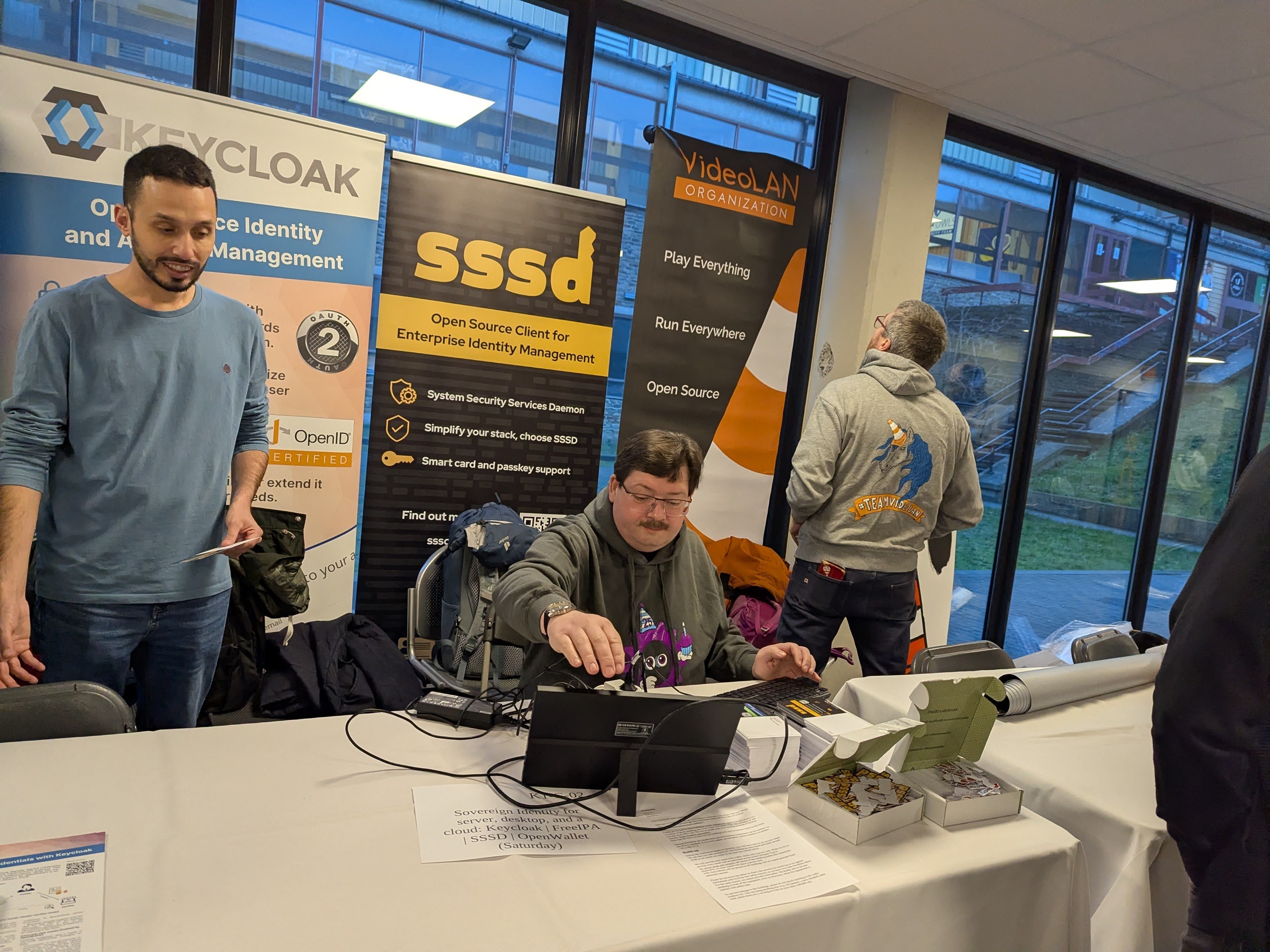 | FOSDEM stand: initial setup |
There weren’t many people in the first part, but after 10 o’clock things changed, probably because many people had already attended the initial Keynote and were now on campus. We welcomed several people who were using FreeIPA and SSSD. Some had specific questions or wanted to know more about the projects. For example, a couple of Japanese people told us that they wanted to migrate their company’s infrastructure and that after initial analysis they had decided on SSSD. It met their needs and they could see that it was well supported.
In another case, one of our stand neighbours (VLC) told me that in his work as a consultant he had migrated several organizations to SSSD. He also told me that he had a client who used AD and was looking for a Linux client that supported it. I told him that SSSD was the client he needed, and he was surprised to learn that we had been supporting it for years. Other people were unaware of the projects and were very surprised to learn that they were more than 15 years old.
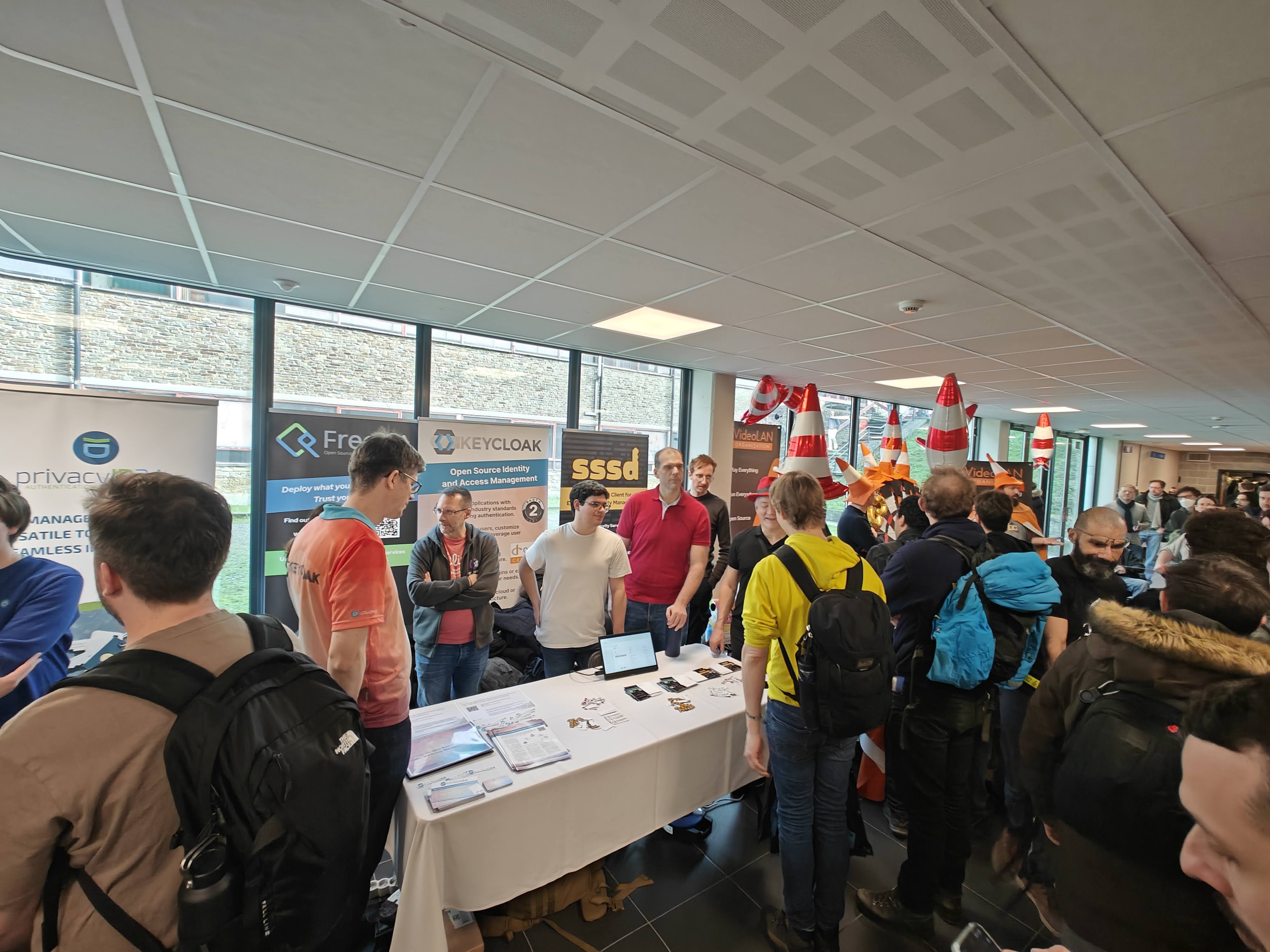 | FOSDEM stand: visitors |
@LinuxGuides, an influencer, interviewed André and me about SSSD and FreeIPA. We shared basic details about what it is and how it works.
On a personal note, I must say that I had a great time at the stand and it is an experience I would like to repeat. So much so that, although I was assigned to the morning shift, I spent most of the day at the stand and its surroundings. Throughout the day, people stopped by to say hello and learn more about the projects. Well, and to pick up stickers. We also received a visit from Open South Code, a conference held in Malaga at the end of June, to invite us to attend. Right now I’m thinking about what topics I can present at this conference.
Devroom
On Sunday, it was the turn of the devroom. Something that several of us already know very well. Overall, we had a very good turnout. In the morning, the room reached its 100-person capacity immediately and stayed full the whole time. We had long queues outside with a ‘one-in, one-out’ policy enforced by safety, meaning many people unfortunately couldn’t get in. From lunchtime onwards, attendance began to drop, although there was still an audience.
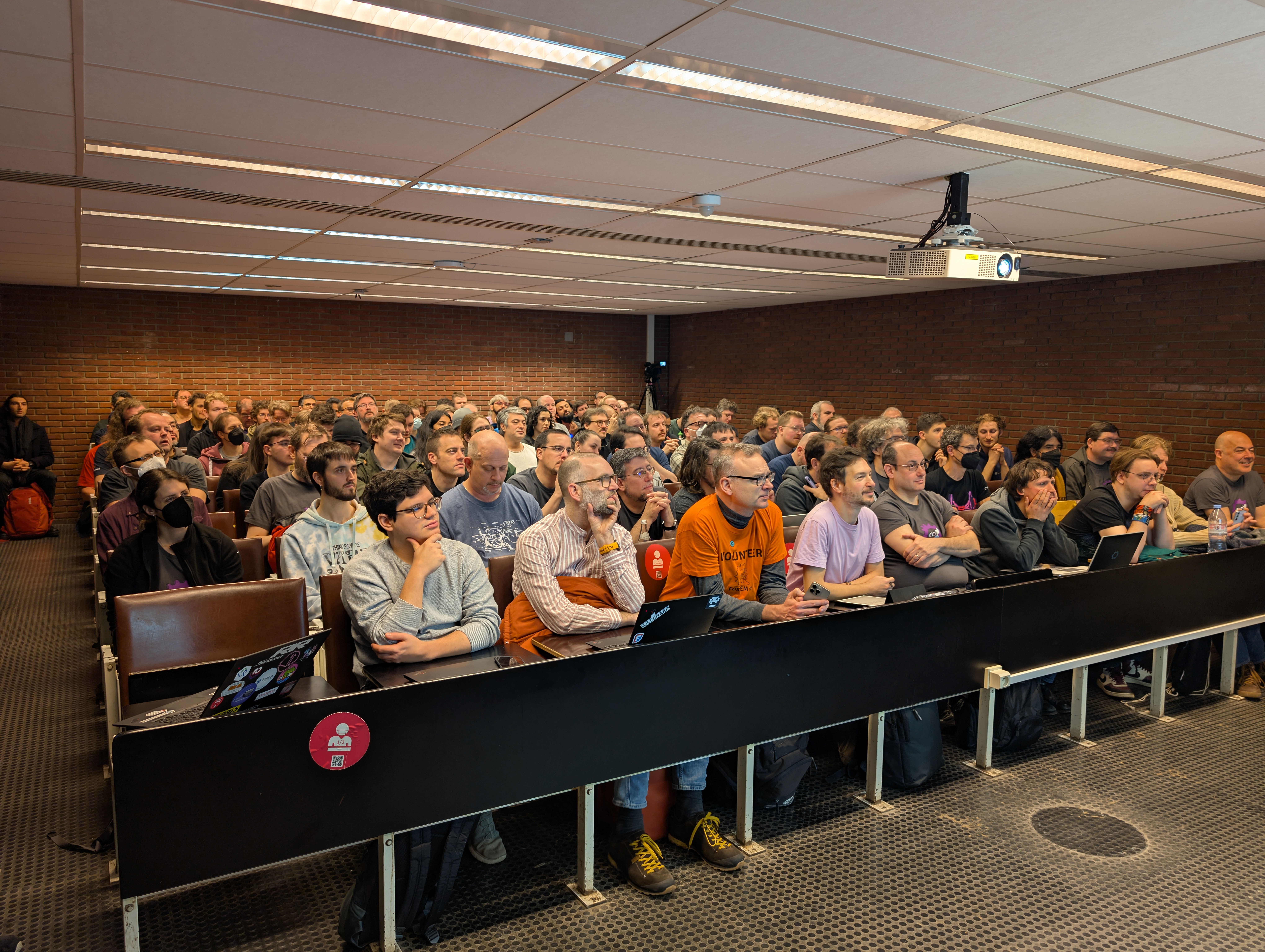 | FOSDEM devroom: audience |
The talks covered a wide spectrum of IAM, and among those I attended, I would like to highlight the following topics:
- Privacy and sovereignty: one of the talks I would like to highlight was maddog’s on privacy and sovereignty in a post-quantum world. The talk was very motivational and energetic, which helped keep people engaged and enthusiastic. I would highly recommend watching it if you are interested in the topic.
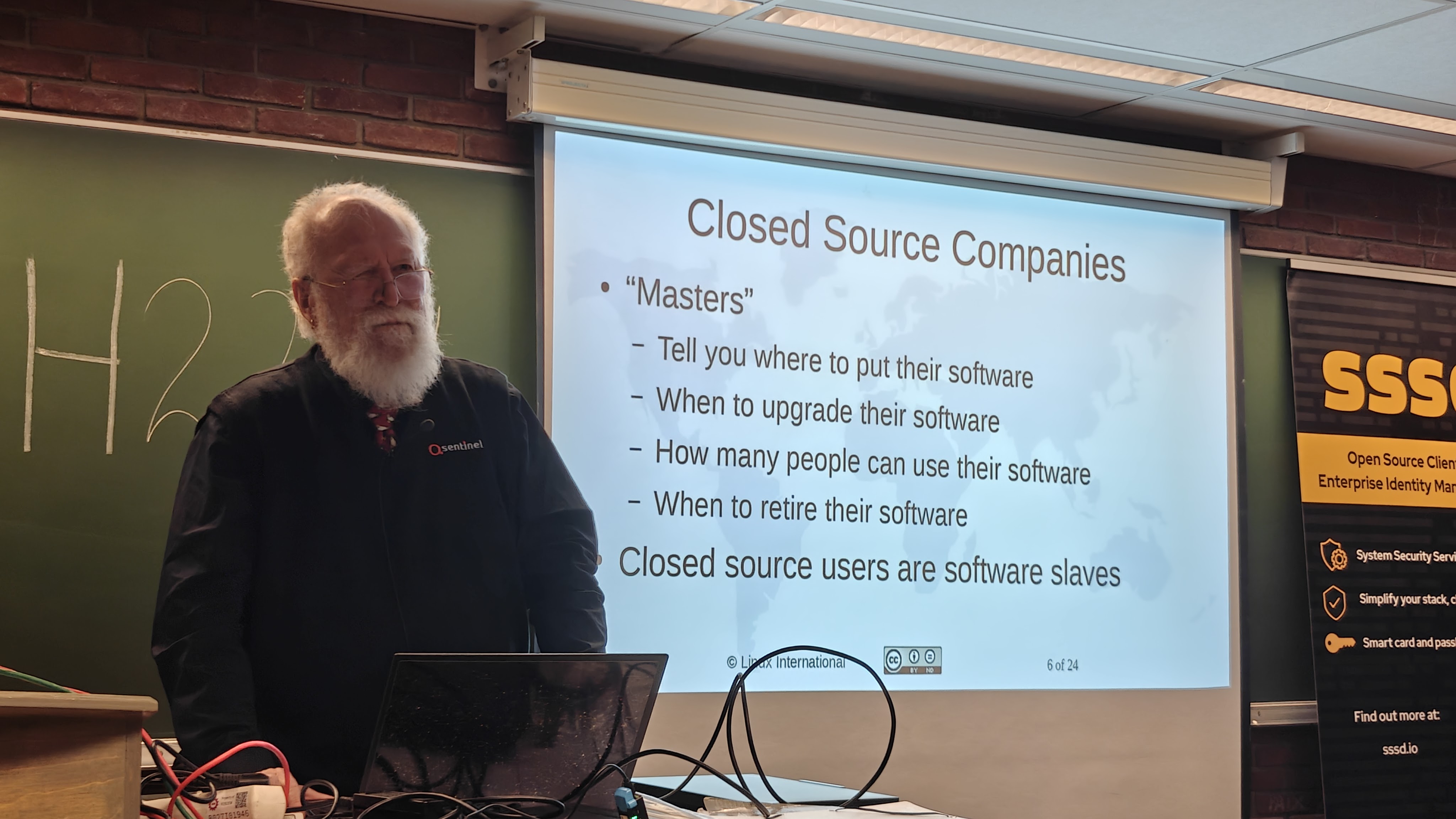 | FOSDEM devroom: privacy and sovereignty |
-
SUSE IAM architecture: another interesting talk was the explanation of how SUSE IAM works. They have a complex architecture inherited from acquisitions, and the user experience is poor and complex. The speaker shared several diagrams of the architecture, which included DS389 at its core.
-
Passkey/FIDO2 integration: one topic that came up repeatedly in several talks and that interests me deeply is passkey/FIDO2. From a system library that aims to abstract communication with devices and provide a single interface through DBUS to the integration that Freya is working on with cockpit. It’s very interesting because this implementation and talk began at the reception of our hotel during DevConf 2025. Related to this topic is the talk Joan and I gave on passwordless-GDM integration in the graphical interface. In this talk, we focused on explaining the problem and how we are improving the graphical interface to adapt to the new times.
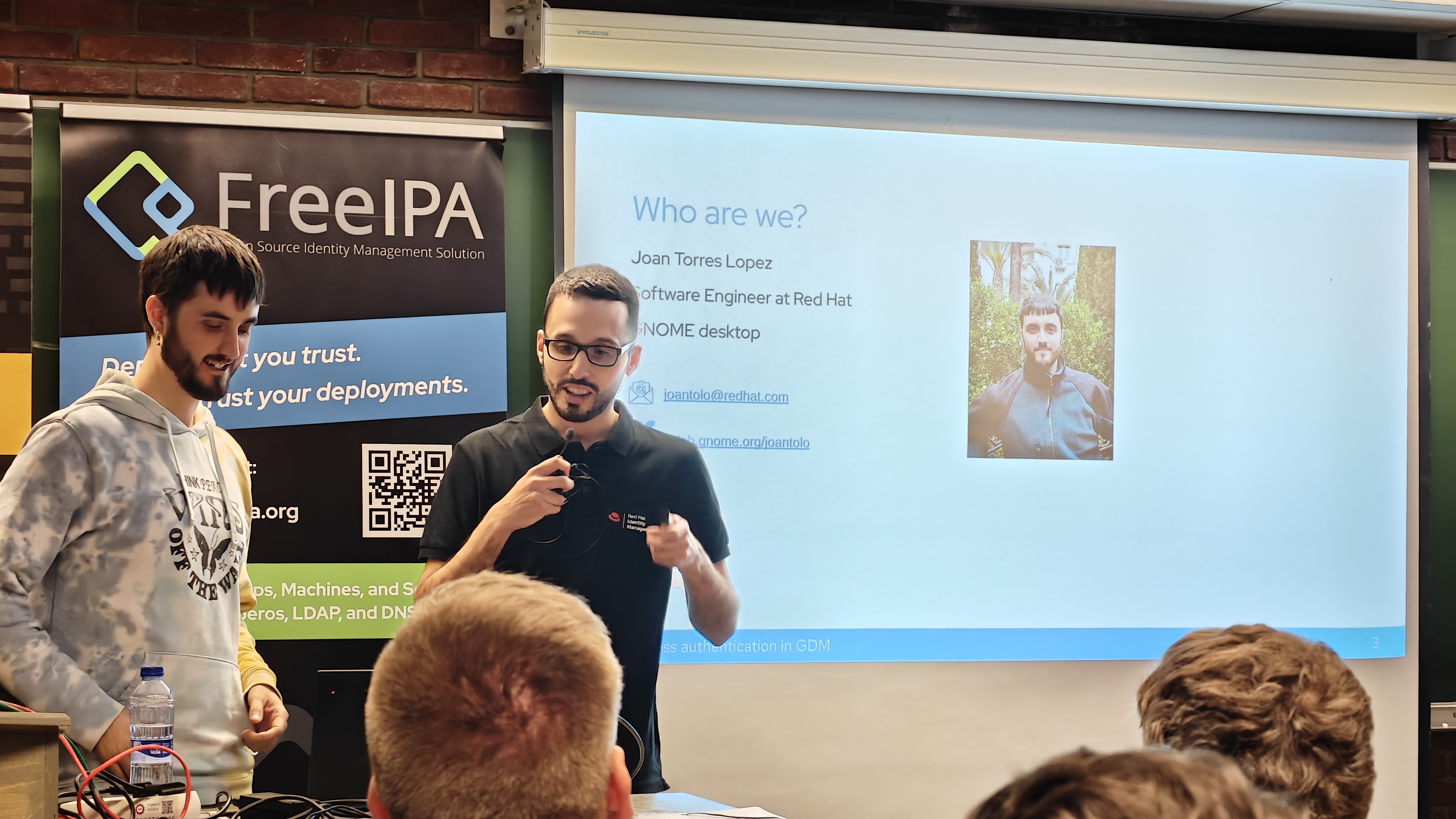 | FOSDEM devroom: passwordless-gdm integration |
- AI in IAM development: to round off the devroom, we had Thomas’ talk about his development of the new CA backend with the help of AI. The talk was very entertaining and I loved the approach.
Schedule and recordings of the sessions are available at: FOSDEM 2026 IAM Track.
Finally, I would like to add that the conference allowed me to have many hallway conversations with old and new acquaintances. This has allowed me to better understand the problems faced by some of our users and to synchronise with them on several developments, such as passwordless-GDM and a RISC-V project I am working on with an external collaborator, which aims to eliminate the need to create specific Fedora images for a particular SoC.